

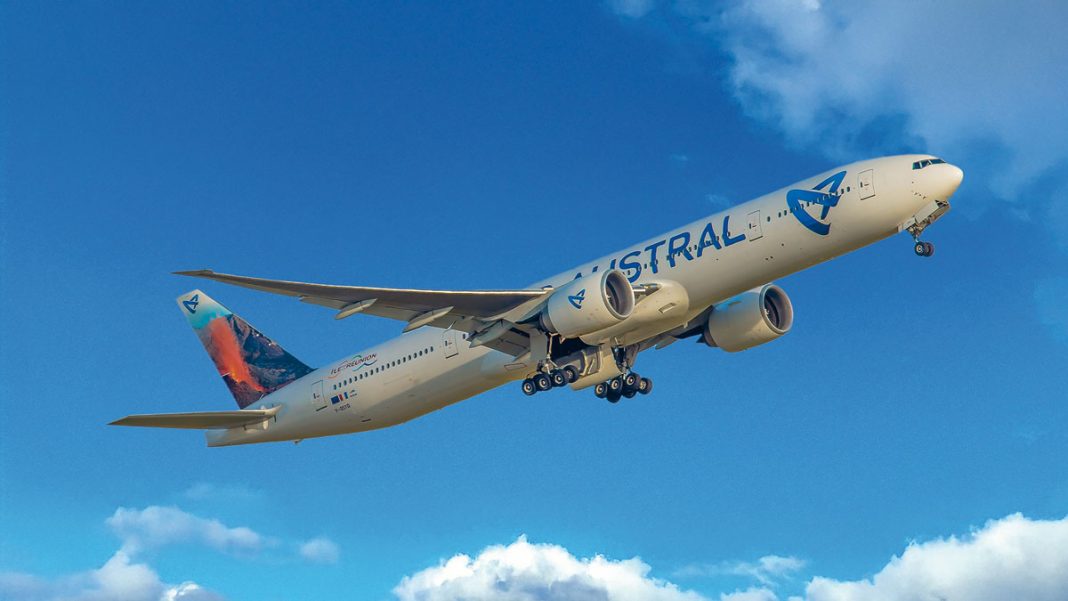

The new Persian Gulf War highlights the relevance of Air Austral's development model based on connectivity across the great Indian Ocean from its central regional hub.. A network of which the company resolutely pursues the extension and ramification. Hugues Marchessaux’s explanations, its Chairman of the Board.
Meeting Leader : As an Indian Ocean air carrier, What do you learn from current events in the Middle East? ?

Hugues Marchessaux : The major question mark for airlines, this is the duration of this crisis. Flight safety is obviously the number one priority. The question therefore arose of banning French-flagged companies from the Red Sea corridor bordering Saudi airspace.. The DGAC has so far heard the arguments of companies serving the Indian Ocean. Several African airspaces are themselves prohibited from overflight (Sudan, Niger, Libya), we would have to go through West Africa, i.e. 2h30 additional flight on average, 20 tonnes more fuel, and operational issues, particularly during crew rest times, extremely complicated to implement. Another consequence of this crisis : Air Austral was requested to repatriate stranded travelers. We went to the Maldives to pick up passengers who had returned to France via Reunion. Other passengers stranded in Bangkok choose to go through Reunion Island to reach Europe.. Our Bangkok-Reunion line thus recorded a strong increase in reservations. But the question now, it is the possible recomposition of the aerial landscape if the conflict lasts. There is the increase in prices to deal with the explosion in the barrel of Brent, went from 60 to more than 100 dollars in three months. But there is also a deeper reflection. The crisis questions dependence on Gulf hubs, weakened by geopolitical tensions. The meeting, stable and strategic, could become one of the alternatives. What will they do, For example, islands like the Seychelles and the Maldives if Gulf companies, on which they are extremely dependent, are no longer able to serve them, in any case with the same frequency ? Reunion may not be located on the natural path to these islands, as in Asia, but it offers incomparable guarantees of stability. This state of affairs reinforces Air Austral in its development strategy, which is to promote connectivity.
Air Austral’s inter-island and ocean network continues to expand. How far do you want to develop it? ?
We want to continue to develop intra-regional traffic, that is to say, to connect our regional lines with our long-haul network. Not just Reunion and Mayotte, but also Madagascar, the Comoros, Maurice, Rodrigues. On the one hand, the Bangkok hub opens Asia to us. On the other, the Johannesburg hub opens Africa to us. And then of course Paris to shine in Europe. This is our strategy and what differentiates us from our competitors. To expand our network, there are two approaches. Firstly, there is what we can do with our program. So we are considering serving Cape Town directly in the future.. We have just restarted service to the Comoros on a seasonal basis. We are looking in the Indian Ocean to see if there are other opportunities. Beside that, we rely on cooperative partnerships with other companies. for example, the IndiGo company opens the Chennai-Reunion link at the end of April : setting up cooperation with this company on this destination is part of our thoughts. Or, the agreement signed with the German company Condor, which is the result of work with Île de La Réunion Tourisme. Condor serving Mauritius, our cooperation facilitates the arrival of German tourists in Reunion. On the other hand, the agreement with Air Calédonie International results from the fact that this company serves Bangkok to serve Paris. Our planes land in Thailand an hour and a half apart, which allows the people of Reunion to return to Nouméa. We are thus developing, gradually, our network and allow our customers a much wider range of connecting destinations.
What is the issue of fleet renewal in this strategy? ?
It is to strengthen our network, to make it reliable and develop it. We will initially renew our medium-haul fleet. The A220 only has 132 seats and its engine is problematic, which makes its operation complicated and expensive. We want to be able to offer higher cabin capacities and take a little more cargo with the A320 and its 180 seats.. This gain in capacity will allow us to work on our prices. These new planes will be intended for the Indian Ocean zone. We will start with two planes, we will then see if there is a need to increase the fleet. The last A220 will leave us early next year.
What are your cargo goals? ?
Cargo represents 8% of our revenue. We want to increase our capacities to meet demand, particularly between Reunion and Mayotte. We hope to achieve this with the A320. Freight between Asia and Europe is another opportunity. in charge, our Bangkok-Reunion flights have their holds full. This freight transits through Reunion Island for France. Capacity on the Asia-Europe axis is not sufficient. They will be even less so with the Gulf affair. This is clearly another avenue for development for us by capitalizing on our position in the Indian Ocean..