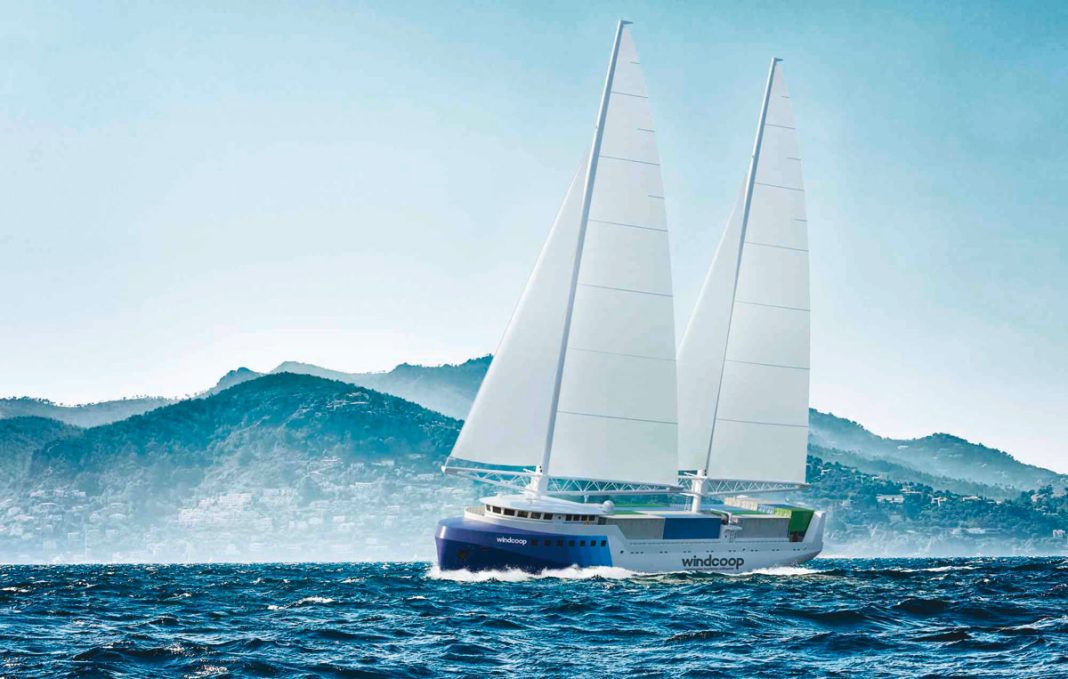

The maritime cooperative behind the Miaraka sailing container ship, currently under construction and which will connect Marseille to Madagascar next year, carries a second low-carbon maritime transport project in the Indian Ocean : a sailing cargo ship for inter-island trade. Windcoop’s development director, Erwan Gambert, stopped off last month in Reunion Island to survey the island’s stakeholders involved in regional trade. Guest of the Club Export Meeting on April 23, he presented the terms of the economic equation of the project in its current form and collected the expectations of several operators faced with the lack of maritime freight in the area.
Meeting Leader : What is the purpose of your trip to the Indian Ocean?, particularly in Reunion ?
Erwan Gambert : The first rotation of our container ship on the Marseille-Madagascar line is scheduled for July 2027. In Madagascar, I visited our future clients, also members of the cooperative, so that they confirm their intention to embark on the adventure. Between mainland France and Madagascar, 51 companies have in fact signed letters of intent ensuring that they will load with us. I also came to think about a second project : a model of a regional bicycle transport line. Following the contacts we have made in the region, we are starting to discern its contours a little better. Feedback from the field is rather positive. Hence my presence in Reunion Island to get to know the local players that this project could be interested in and their regional freight needs..
What is the finding ?
The discussions I had confirm this : there is a real demand for regional maritime transport. Large shipping companies have their own problems, notably on the East-West line linking Asia to Europe which passes through the islands of the south-west of the Indian Ocean. The flows supported by the majors operate in one direction only and these majors are not intended to ensure regular inter-island maritime transport.. Between Madagascar, The meeting, Mauritius and Mayotte, our sailing solution would provide a complementary service, a source of added logistical value for importers, industrialists and traders in the area, both in terms of logistics efficiency, freight rates and decarbonization. On the future Marseille-Madagascar line, sail propulsion must reduce CO2 emissions from maritime transport by 60%. I add that the Windcoop model is cooperative : we operate as an agricultural cooperative, where it is the farmers who invest in their common means of production. With this model, Reunion operators, from Mayotte, of Madagascar and Mauritius would regain control of inter-island trade by investing in a certain way in what will be their ship.
What's next ?
Before going any further, we need to assess the volumes that could be exchanged and between which ports. It is only from there that we will be able to design a boat sized for these volumes and determine the gain in decarbonization of transport.. Regarding prices, our first simulations show that we would be within market prices by transporting 50 containers monthly between Madagascar and Reunion and the same between Reunion and Mayotte, i.e. 100 containers. Strengthened by these elements, we want to form a coalition of shippers committed to decarbonization, interested as customers but also as members by this means of maritime maritime transport, and who would be ready to sign letters of intent for us. This will be a first step to make the project viable and to present it to other partners..
What is the principle of letters of intent? ?
Without having any commitment value, they will demonstrate their willingness to contribute to the project and work with us once the boat is operational. With the support of these letters of intent and if the potential loading volume announced is sufficient, we will pursue three tracks in parallel. The first one, that of marketing, because this core of chargers will not fill the boat alone : we will need to aggregate more charges.Second track : ship engineering studies, the technical part. The third track will be that of financing. The letters of intent will be proof of the economic credibility of the project. This is how we proceeded to complete the financing, with the help of a bank and the container ship Miaraka, currently under construction.
If you receive enough letters of intent, how long would it then take to cast the line ?
Given the construction time of the boat, a prospect of entry into service within two and a half to three years seems reasonable to me.
In addition to CSR regulatory requirements, low-carbon transport should be a selling point for a brand or a supplier : Is this aspect mentioned by the people you meet? ?

Quite little, I have to admit it. Our project, I specify it, also takes into account the treatment of sailors on board. There is a cluster of committed actors who, whatever happens, whatever it costs, will go in this direction. However, they are still a minority. Most shippers look at the logistics solution first. So that a carbon-free maritime service has a chance of success, it must respond to a logistical problem without being disconnected from market prices.
Is there a label or certification linked to sail transport? ?
L’association Wind Ship, which brings together the sailing maritime transport sector, works with Afnor on this issue. This involves developing specifications. This is indeed a challenge for the sector.
To know more
Windcoop :
Erwan Gambert,
development director : 06 45 90 03 17
erwan.gambert@wind.coop
Export Club Reunion :
Alexandre Beaufays, responsible
international development :
06 93 31 51 31
alexandre.beaufays@clubexport-reunion.com