


When a few cents more per cup changes everything… The Collectif Café sheds concrete light on the price of this drink and its values. A new plea in favor of “specialty coffee”, better tasting and better remunerating producers.
Traditionally, coffee is considered an agricultural raw material listed on international markets (commodity). Second most consumed drink in the world (after the water), it is the most traded and supports nearly 25 million producers, mainly in tropical regions. From production to marketing, it generates millions of jobs . Its price is mainly determined by the balance between supply and demand but also by meteorological factors, economic and social. So, global warming, the decline in the number of producers and the increase in global demand reduce supply, leading to significant fluctuations. In 2025, world prices have reached historic levels. The increase in global consumption with the emergence of new consuming countries (including China and South Korea) will reinforce these tensions and the volatility of a market which is already suffering from low stocks and poor harvests.
How is the price of coffee constructed?
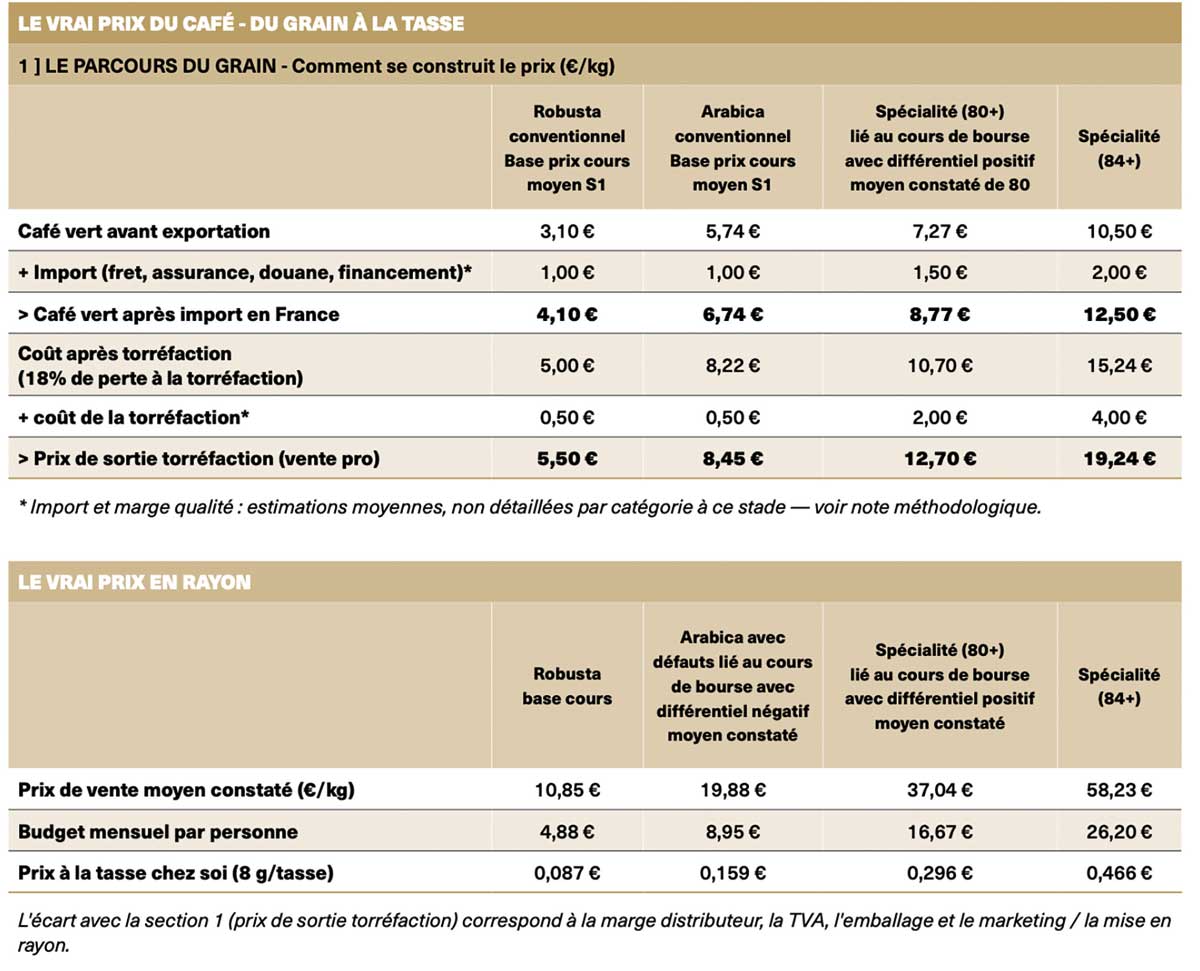
The Collectif Café study analyzes the phases that make up the price of coffee from bean to cup. It highlights the value created at each stage of the supply chain.. Buying green coffee, exportation, importation, roasting, distribution and marketing… from producer to consumer, several elements contribute to the final cost.
Historically, producers received a small share of the value of their production. The rise in prices now offers an opportunity to better pay their work. Roasting also represents an essential step in creating value. The quality margin of the roaster thus evaluates it to around 0,€50/kilo for standard coffees up to €4/kilo for specialty coffees. This difference is explained by the investments necessary to guarantee quality : batch selection, sourcing direct, certifications, tastings, traceability, and work on small productions.
Too much coffee kills coffee
But in this model, value is based primarily on volume and market price : two very different coffees can be paid at the same price to the producer. For the Café Collective, the strong growth in consumption and points of sale throughout the world favors standardized production to the detriment of quality. “At this rate, the industrialization of the market risks exhausting the land and the producers who sustain it. The future of coffee therefore depends on its revaluation and informed consumption. : better consider its origin, its method of cultivation, its qualities and the know-how of the producers, in order to encourage a more sustainable and fairer sector. »
Why choose “specialty coffee” ?
A specialty coffee is a coffee that has obtained a score greater than or equal to 80 out of 100 during a professional sensory evaluation., carried out according to criteria relating in particular to aromas, the flavor, balance, complexity and absence of major defects. This rating guarantees a drink with distinctive taste qualities, resulting from rigorous work at each stage, from production to roasting. “Contrary to a logic based on volume alone, specialty coffee offers an economic approach based on value creation”, wrote the study. “Like wine, he values the terroir, the origin, the harvests and the know-how of the producers. By paying more for quality than just volume, it helps to preserve coffee varieties while avoiding a race for the lowest prices, which could weaken the quality of the market. »
 Create value from the start
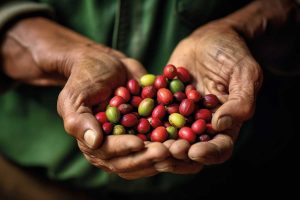
Arabica is more demanding to grow and therefore generally more expensive, underlines the Café Collective. Often associated with specialty coffee, its origin is highlighted because the terroir influences its aromatic profile. More complex and finer, it is also more expensive. The robust ones, on the other hand, became popular thanks to its robustness and ease of cultivation. More resistant and productive and despite a generally earthier taste profile, it can be grown in large quantities at low cost. Between a conventional Arabica and an 80+ specialty coffee, the difference in the price of green coffee makes it possible to improve the remuneration of producers by around 25%. “This valorization encourages more demanding agricultural practices, helps to preserve terroirs and promotes more sustainable relationships between producers and players in the sector. »
Convenience Coffee vs. Specialty Coffee 80+
cents
Average deviation per cup at home.
About 10 cents : average difference per cup for professionals.
The additional monthly cost for an 80+ specialty coffee consumer.
Estimated improvement in producer remuneration between conventional Arabica and specialty coffee 80+.
Prices recorded in mass distribution for 4 references of conventional coffees, for robusta and arabica categories, and for specialty coffees (Arabic 80+ and 84+), at roasters who are members of the Collectif Café. Cost per cup calculated based on 125 cups prepared with 1 kilo of coffee (or approximately 8 g/cup).
The French and the café
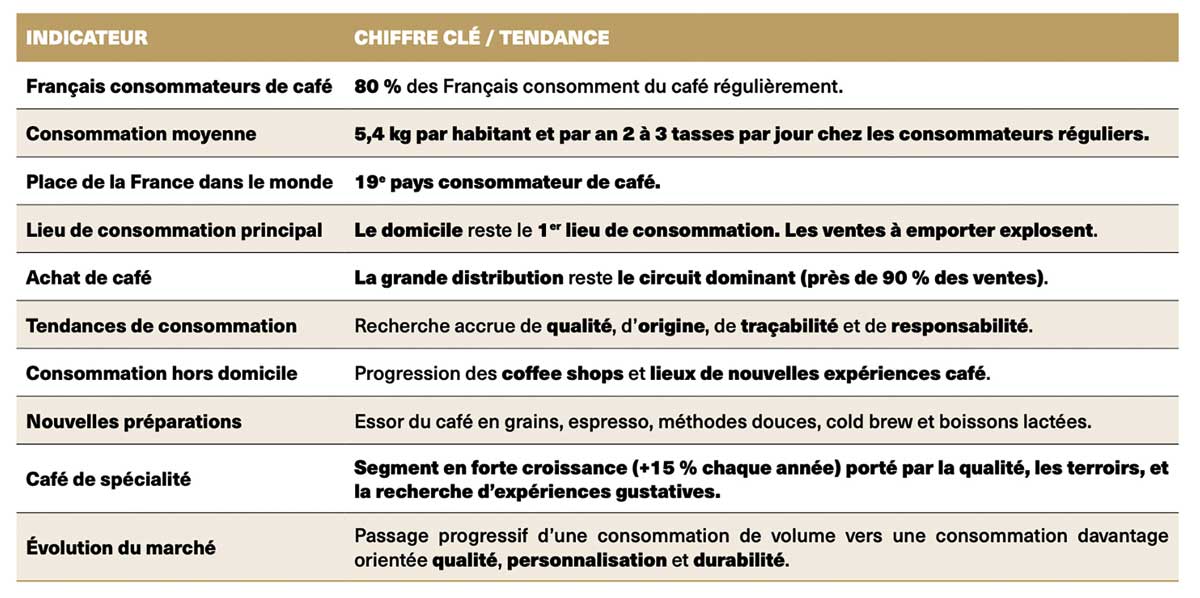
In France, coffee remains one of the most consumed drinks on a daily basis (see table). 90% of sales concern convenience coffee distributed in supermarkets. The real difference is no longer between consumption at home and away from home, but in the purchase format : when coffee is sold as beans or ground per kilo, the price is mainly perceived by weight, often associated with a notion of accessible price ; conversely, the capsules, pods and coffees consumed in store are compared to the cup and the price then becomes more readable and put more into perspective with the quality and experience offered.