
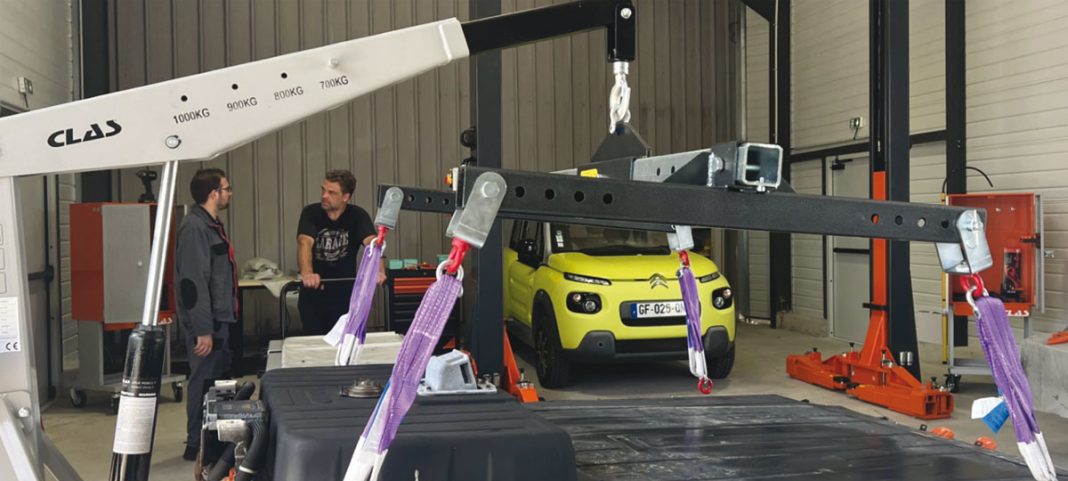

Member of the first network of used parts, Caréco, and independent actor in automotive recycling, The actor of automotive recycling and re -use of Gièvres Auto spare parts innovates by creating the first workshop devoted to electric and hybrid vehicles integrating diagnosis, expertise, dismantling and recycling.
 In France, The electrified rolling stock now represents more than 1,4 million vehicles. Today, It is estimated that more than 13,000 electric and hybrid vehicles out of use (VHUE/H) must be treated, Or 1 % of all the vehicles treated in specialized recycling centers, and their number is increasing among the volume of damaged vehicles breaking into breakage.
Recycling of electric and hybrid vehicles, and more particularly batteries, imposes means, Complex and secure regulations and procedures. Indeed, the treatment of dangerous components and metal recycling, whose rare metals in batteries, require very technical and rigorous processes. Out of use vehicle centers (VHU) must have authorized operators B2VL / B2XL / B2TL. The latter are the only ones authorized to intervene on electric and hybrid vehicles at the end of life, as well as on batteries intended for re -use or recycling.
The battery passport
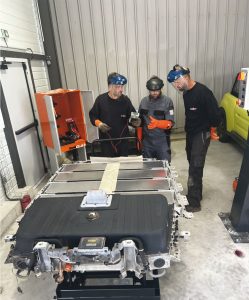
In this context, European regulations relating to batteries and battery waste requires manufacturers to enter the carbon footprint of each battery. There is now a "battery passport" which, From mining to recycling, Allows you to follow your treatment. Upon arrival, Out of use electric and hybrid vehicles are subject to crucial diagnoses. The risk of explosion and fire must be identified via a systematic thermal control of the battery pack. Any vehicle "at risk" (having been submerged, burnt down or seriously accident) is stored on a specific area with fire-cutting walls (Four -hour resistance to fire on the Caréco Gièvres Auto site), called "quarantine", Under-survence. After having removed any electrical risk, fire, explosion or chemical problem, A new battery diagnosis is made in a specific workshop, Before his removal to check his charge state (SOC) and his state of health (SOH). The disconnection of the modules comes third, Before launching the disassembly process to the recycling sector. Removal, The opening and diagnosis of the battery require the intervention of two technicians and can take up to half a day in some cases.
Electro-technical-caster : A new job
"With this Center Gièvres Auto Elect, We create a new profession of electro-technical-caster. To recycle electric and hybrid vehicles out of use, and mainly batteries, We had to develop skills, Specific equipment and infrastructure. This requested a substantial investment in detection tools, surveillance and storage. In 2024, More than a hundred batteries from electric and hybrid vehicles have been deposited in our center. Today we have real expertise in the field. We are more and more asked and mandated for removal throughout France, for the provision of our infrastructure, But also for our skills during contradictory expertise ", comments Nelson Jourdin, Director De Gièvres car.
Used batteries : Reunion also at the forefront
Suez Recycling and Réunion Valuation opened, within its transit platform for hazardous industrial waste in Saint-André, The first pre-treatment and packaging workshop of used lithium-ion batteries of electric vehicles from the Suez group. These batteries are then shipped in mainland France to be dismantled and recycled.
See Leader Meeting, n°238, February 2025, and on leaderreunion.fr.