
An ecological solution imported from Korea arrives on the French market for restaurateurs, Hôteliers and communities managers, who are obliged to manage their bio-waste since January 1, 2024.
Biowaste, organic waste of plant or animal origin, from the kitchen, catering, today represent almost a third of the contents of French people’s residual trash, or 30%, and those generated by the consumption of meals outside the home (CHD) weigh 720,000 tonnes according to Ademe. With the anti-waste law for a circular economy, promulgated on February 10, 2020, companies and communities whose annual waste production exceeds 10 tonnes or 60 liters for oils have the obligation to sort their bio-waste and have it recycled in appropriate sectors. The volume was lowered to 5 tonnes on January 1, 2023, until the elimination of this minimum since January 1, 2024. Within the framework of this Agec law, the restaurants, hotels, Ehpad, hospitals and communities therefore have the obligation since January 1, 2024 to reduce, sort and recycle their bio-waste. According to article L123-1 of the Construction and Housing Code, which completes this law, managers of restaurants and communities must provide bins in the kitchens reserved for the management of bio-waste, distinct from other waste.
Biowaste transformed into wastewater
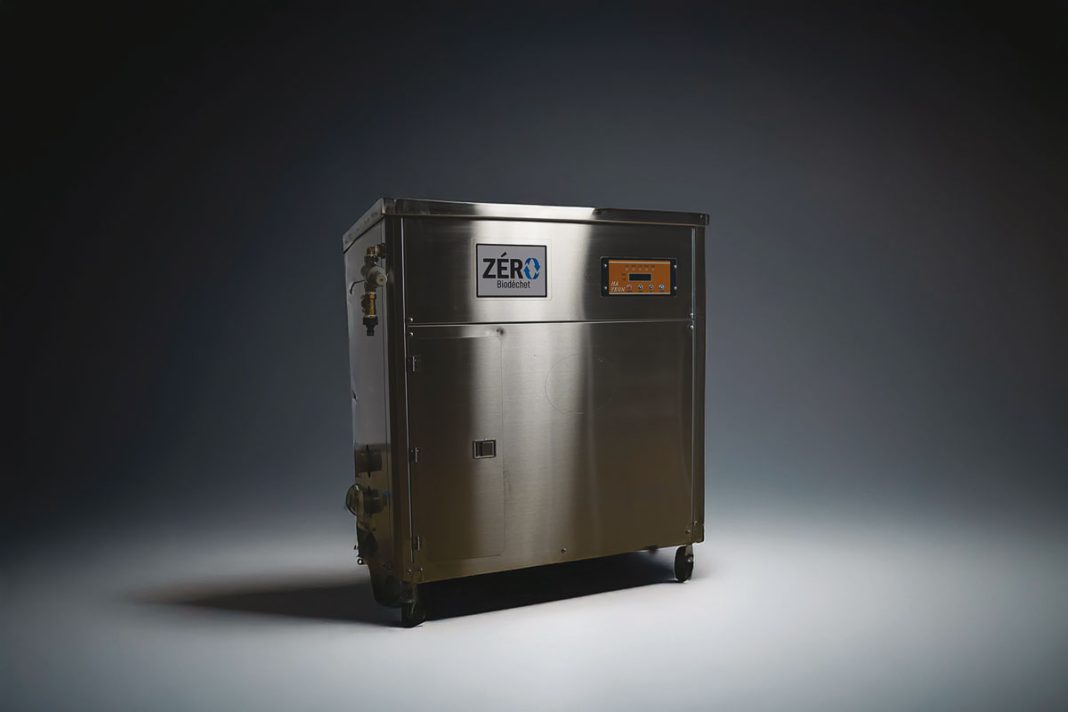
Imported from Korea by Yejin Mulot and her husband, director of the Mulot group, specialist in oyster farming equipment, a machine transforms bio-waste into non-polluting waste water in just 24 hours and is now available in France. Thanks to natural microbiota, this technology fully breaks down food waste such as service returns, leftover food, the peelings, le poisson ou le pain. Marketed by the company ZÉRO Biodéchet, this innovation has many advantages compared to existing solutions to date such as dehydrating crushers or composts, much more energy intensive and which involve many inconveniences in terms of odors and heat. It reduces waste to 95% of its initial volume. Designed to be energy efficient, it works optimally without affecting electricity costs. Perfectly suited to professional kitchens, it fits easily into existing spaces. Odorless, it eliminates the inconvenience linked to bad odors and pests. It eliminates waste storage spaces with a more hygienic and organized workspace. Finally, it contributes to reducing the carbon footprint.
 A Franco-Korean design
Originally from South Korea, Yejin Mulot has lived in France for twenty years, country where she dedicated her career to the stainless steel construction industry. Learning that new French regulations now require compulsory sorting of bio-waste, she thinks of South Korea, a pioneering country in waste management, where sorting has been a norm for more than twenty years. “I remember the surprise I felt when I arrived in France in 2004 : here, everything was thrown together ! » Inspired by Korean efficiency, she embarked on in-depth research into the most advanced and proven technologies and discovered machines in Korea using microbiota to transform food waste into non-polluting water in just 24 hours. Yejin Mulot selected the best Korean technology and optimized it thanks to a partnership with a French laboratory specializing in microbiota and with the support of her husband, director of an oyster equipment company. Together they adapted the machine to the French market. This synergy gave birth to ZÉRO Biodéchet. Last November, innovation caused a sensation at EquipHotel 2024, arousing the interest of many personalities, dont Guillaume Gomez, former chef of the kitchens of the Élysée and ambassador of French gastronomy.