
The search for innovative solutions permeates all activities of SUEZ Recyclage et Valorisation Réunion. So many sources, for the operator, reliability and differentiation on the local waste recovery market. Four examples of these solutions and four faces of those who bring them to life every day.
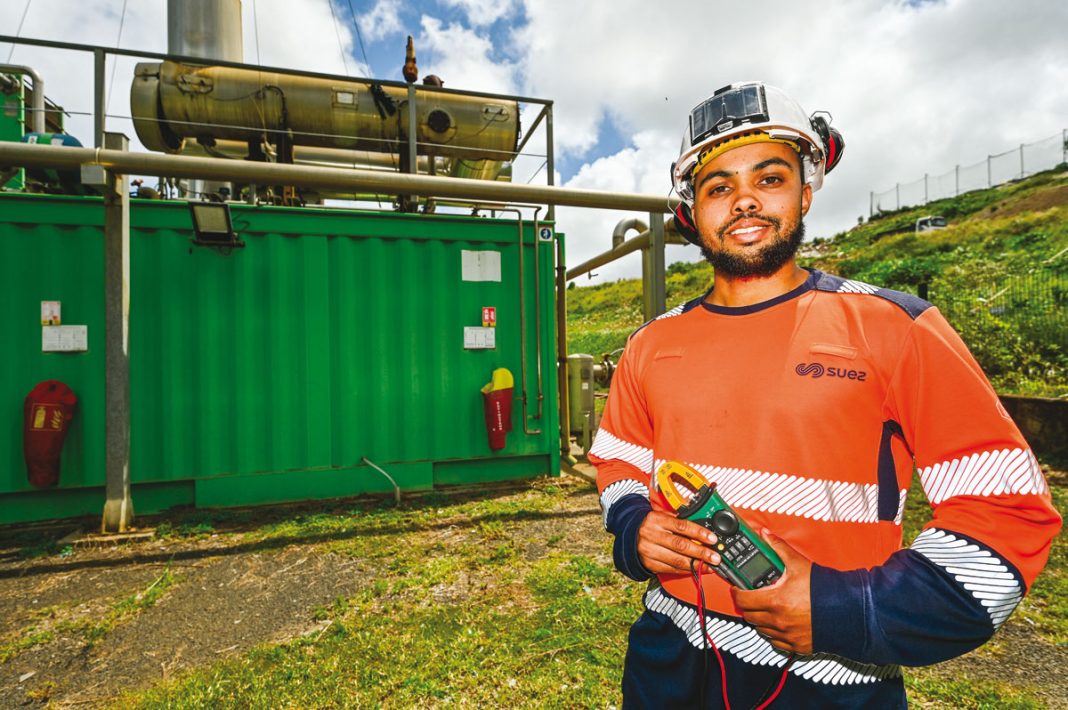
Landfilling is not the end all be all when it comes to waste. The production of biogas on the ISDND of Sainte-Suzanne is proof of this. It does not date from yesterday and, regardless of the mandatory nature of the management of methane emissions, it is part of the solutions that make SUEZ RV Réunion one of the main players in the circular economy in Réunion. “Biogas is produced by the effluent of organic household waste which ferments. Methane is a greenhouse gas. Its energy recovery is therefore doubly useful. It protects the atmosphere and provides an additional resource through the electricity sold to EDF.”, explains Yohan Fombard, maintenance technician of the biogas platform at the Sainte-Suzanne eco-pole since October 2025. Recovered by harvesting wells, methane powers two engines which can produce up to 2 MW supplying the general network, i.e. the equivalent of the annual electricity consumption of 1,500 to 2,000 homes. A subsidiary company of SUEZ RV Réunion, Bel Air Energy, sells this electricity to EDF. When biogas cannot be valorized due to lack of sufficient quantity, he is burned in flares. For Yohan Fombard, recruited by Suez in mainland France in 2024, this valuation also has a personal value. It allowed him to return to his island thanks to SUEZ RV Réunion. “With wind power and hydraulics, the energy recovery of biogas is a third renewable energy which helps to make Sainte-Suzanne one of the rare municipalities in France with positive energy, that is to say where we produce more energy than we consume”, recalls Yohan Fombard. This addition to the Reunion renewable energy mix deserves to be highlighted.
Water, a circular economy
“My mission is to study and supervise solutions for controlled management of the site’s water consumption.. Recover the leachate water, after purifying it, for its internal reuse is one of these solutions”, says Hugo Ernst-Hirsch, environmental project manager of the Sainte-Suzanne eco-pole. Hugo Ernst-Hirsch was recruited by SUEZ RV Réunion a year and a half ago at the end of his study internship in the company. This circular economy of leachate water is called reuse. (reuse). Product of decomposition of waste and runoff water, leachate is collected by a drainage system. It is subjected to biological treatment, then physicochemical, before being purified by reverse osmosis. This separation process is used here to recover water free of its pollutants (pressurization, the solution passes through a series of membranes). Four treatment units are in operation at the Sainte-Suzanne eco-pole. The objective is to recover more than 70,000 m3 of water per year. This water is currently used to water the traffic routes in order to limit dust.. This use was deemed a priority for the health of employees and the protection of the neighborhood.. The goal is of course to improve the performance of the system in order to be able to develop other uses.. From next year, an evaporator will increase water production. “The landfill, after its closure, aims to become a green space, and I am currently studying how we can use this water to water its future landscaping. », confie Hugo Ernst-Hirsch.
Collection : eco-responsibility while driving
For 20 years at SUEZ – “and I’m proud of it” –, Lyndie Hoarau is now the operations manager of the ordinary industrial waste activity.. She manages a team of 54 people, at the wheel of 45 vehicles ensuring the collection and transport of DIBs for professional customers (industrial companies, grande distribution, Reunion-Roland-Garros airport, etc.), to the SUEZ sorting plant. In this “piloting”, the health and safety aspect of personnel occupies a fundamental place.
Lyndie Hoarau's missions include ensuring strict compliance with driving and break times., defined by European social regulations (the other CSR) : 45 minute break after 4.5 hours of driving. In addition to the obligatory nature of CSR, respecting good driving practices is part of the quality of the service provided by SUEZ RV Réunion for its customers. Aware of security issues, for them and for the company, drivers have been benefiting for some time, to help them, an innovative solution for transmitting tachograph data. The tachograph is this electronic device recording speed, driving and rest times on all road transport vehicles over 3,5 t. “Oclock terminals are small data unloading boxes designed for the SUEZ group. We put them in place in our centers. All the driver has to do at the end of the day is insert their data card into the terminal so that the information is instantly transmitted and its CSR compliance verified.”, specifies Lyndie Hoarau. Result : violations of break and driving times are now residual. “Eco-responsibility, this is also for us”, comments Lyndie Hoarau.
Neutralization of lithium batteries : a specialty
Although the REP sector for electric vehicle batteries is not yet in place, the collection and pre-treatment of lithium-ion batteries for their shipment to mainland France is an already operational service from Suez RV Réunion. It is aimed at car dealers, breakages, solaristes, etc., having stocks of used or damaged batteries. two years ago, the SUEZ RV Réunion lithium battery management workshop was the first to see the light of day within the SUEZ group. It is notably thanks to this pioneering workshop that the methods of neutralizing lithium batteries were developed and are now implemented by the group.. We owe this progress in large part to Jérémie Fontaine, young engineer specializing in energy, at the origin of the research and development work carried out within SUEZ RV Réunion for the management of end-of-life electric vehicle batteries. A work carried out as part of his end-of-study internship. Became a project manager, Jérémie Fontaine wrote the operating procedures, managed the construction work of the workshop and trained its operators. Innovation also concerns tailor-made packaging designed for secure shipping of this risky waste by boat to mainland France.. “Many parameters must be taken into account. The difficulty comes from the very wide variety of battery models and technologies. Also the weight of this material which is difficult to handle : 300 to 400 kg on average for an electric car battery”, describes Jérémie Fontaine. Neutralizing a lithium-ion battery takes one to two days ! It is therefore a complex know-how that SUEZ RV Réunion can be proud of having contributed to developing..