
The "French consumption of imported agricultural products : What impacts, What solutions ? », Made by Basic (Societal analysis office of collective interest) and commanded by Greenpeace France, Max Havelaar France and the Veblen Institute, shows for these "urgency of a change of model and the need for regulation".
 The purpose of this study was to reveal the impact on human rights and the environment of agricultural imports to France. Behind everyday products like cocoa, coffee, rice, banana, palm oil or vanilla hide "worrying realities for populations, ecosystems of producing countries and the climate ”, estimate the sponsors of the study. "Faced with these observations, the implementation of European green pact regulations, precisely aimed at strengthening requirements for products imported on the European market, appears as an emergency ! However, The debate is in full swing to lower their ambition with the proposal of the Omnibus package and the race to sign the free trade agreement between the EU and the Mercosur. »»
Socio-economic evaluation
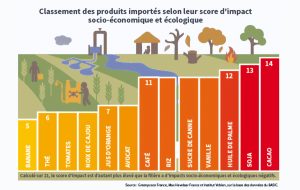
The study of the basic assesses socio-economic impacts (children's work, forced work, standard of living) and ecological (climate, eau, biodiversity) From the main agricultural import channels to France. It also analyzes the potential of three essential European legislation to improve the sustainability of supply chains (imported deforestation, duty of vigilance and forced work) and in contrast the risks linked to the implementation of the trade agreement with the Mercosur countries. According to this study, Six major sectors - cocoa, vanilla, rice, palm oil, cane sugar, Coffee - concentrate human rights violations : children's work, forced work, indecent wages. "In these six sectors, Workers receive less than 60 % of a vital income. Two sectors concentrate major impacts on the environment : cocoa and soy have a significant impact on the climate, Significant deforestation and water pollution rates. »»
Ecological evaluation
For the climate, The cocoa is deemed the most issuing sector of Co₂, soybean monitoring (imported in large quantities), Then coffee and palm oil. For deforestation, Three sectors are particularly concerned : military, palm oil and cocoa. For water, soybeans, Rice and orange juice are the three most consuming sectors, and cocoa, soybeans and coffee are the most polluting sectors (gray water), Due to the production methods and imported volumes. Vanilla has the most important impact on the water brought to the ton produced.
Transformation levers
Three texts from the European Green Pact can lastingly improve the practices of agro-industrial companies and the traceability of supply chains : The RDUE (Settlement against deforestation), The CS3D (Directive on the duty of vigilance of companies), Forced labor regulations (Prohibition of entry into the European market for products from modern slavery). "The analysis shows that these texts, If they are well combined, cover all the issues identified by the study. They have a major improvement potential, provided that their implementation is rigorous, controlled and ambitious. "The study also rejects the trade agreement between the European Union and Mercosur. "As it stands, It does not guarantee the protection of human rights or that of the environment. It would accentuate the pressure on already fragile ecosystems and weaken sustainable sectors. »»