



Two thirds of women take on all household chores : this is the most edifying result of the housework barometer initiated by Briochin, the Breton brand specializing in natural home care products. An exclusive barometer intended to take stock of the sharing of household tasks between women and men.
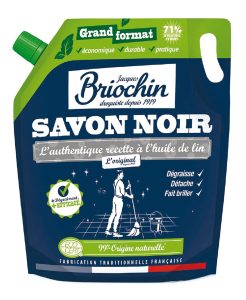
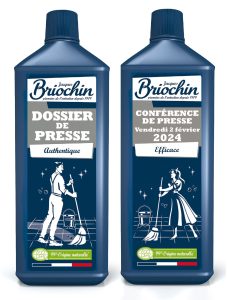
House born in 1919, Briochin is celebrating its 105th anniversary this year, displaying a success that continues to grow. The brand has doubled its number of employees and its turnover over the last five years. Briochin is evolving and today wants to act for a fair sharing of household tasks between women and men. The company has already revised the packaging of its famous black soap in the light of this fairness and will do the same at the start of the year for its window cleaner.. The character of the housewife of yesteryear – who was a real marker of Briochin – will therefore share the spotlight and the tasks equally with a man on the packaging of black soap and window cleaner with an equal version, one feminine and the other masculine, of its packaging on the shelves. “This development demonstrates Briochin’s commitment to taking into account current societal issues, particularly concerning awareness of the place of men and women in society”, affirms the brand in a press release. For further, the French company has decided to take stock of the sharing of tasks within households. Briochin launched a survey of a representative sample of the French adult population in collaboration with the French poll institute&roll.
Briochin, appreciated by the French
This barometer first allowed Briochin to discover that it was the French people’s favorite cleaning brand.. It actually accounts for 11% of the citations, which places it as the first national brand, just behind private labels (17 %). 68% of French people agree that they attach importance to the French origin of household products to limit their carbon impact., and 93% consider it important that household products are as natural as possible to respect the environment. Two particularities that characterize Briochin products.



Two thirds of women take on all household chores
 According to the Briochin barometer, two out of three women (66 %) say they are responsible for all household chores in their household, compared to less than four out of ten men (39 %). 70% of women aged 35 to 65 say they carry out all the tasks. While they are in the middle of an active life, women must therefore also manage the maintenance of the home. 88% of men entrust doing household chores to help their partner, compared to 46% of women. Intrinsically, household chores would therefore be assigned more as a priority to women, while men would only intervene to provide support. The distribution of household chores is perceived differently from the point of view of women and men. 83% of men believe that they are fairly distributed within the household while 60% of women think so. !
Who does what in the house ?
For 83% of French people, women and men combined, men participate more in household chores than before. 86% of men think so and 79% of women. Furthermore, the vast majority of French people (93 %) agree that household chores should be shared equally between women and men as often as possible : 91% of men and 93% of women declare this belief. Beyond household chores, other domestic activities are mostly shared, even mostly taken care of by men. It is an activity that women pay little attention to, it's DIY. Only a third of them say they do DIY compared to three-quarters of men. ! Administrative and financial management is fairly treated by men (73 %) and women (72 %). On the other hand, 79% of women manage shopping, compared to 65% of men. The organization of meals is also mainly taken care of by women : 84% versus 45%.
The household, source of pride
Household chores generate pride : when they have finished a household task, 89% of French people, women and men combined, say they are proud of the result obtained. If cleaning is considered an obligation (67 %) and daily weight (19 %), 15% of French people also associate it with the notion of pleasure ! A qualification which is thus cited more than the “option” propositions (10 %) and “Calvary” (7 %) to define the population's relationship to household chores. Vacuuming and tidying up are the two household tasks that share first place among the French's favorites, if they could choose. They both peak at 22% citation, having to “take care of the laundry” (17 %) then “wash the dishes” (11 %). This distribution of favorites is, however, different depending on women and men.. So, the vacuum cleaner would be preferred by 30% of men, but only 14% of women. They would in fact favor storage (27 %), more than men (17 %). This activity is driven by the desire to take care of laundry (25 %), which only concerns a few men (8 %). In second position, the latter would in fact prefer washing dishes (15 %).
The most gendered household chores
Men are mostly concerned with emptying the trash cans : 84% say they usually take on this task, compared to 67% of women, i.e. 17 points more. The gap is also obvious when it comes to activities related to linen care., in favor of women this time. Changing the sheets (91% women, 53% men) and ironing (74 % vs 26 %) recorded gaps of 38 and 48 points. Starting the washing machine is also mainly managed by women., with a gap of 37 points (88% women vs. 51% men), just like hanging out the laundry, which has a gap of 32 points (85% women vs. 53% men). Deviations of this order are also recorded when it comes to dusting (38 points difference : 49% men vs 87% women), to clean the bathroom (37 points : 47 % vs 84 %) and the toilets (38 points : 52 % vs 86 %).
 The dishes, the most shared of tasks
Washing dishes is a task more shared between men and women. The dishes are done by 69% of men and 78% of women, i.e. nine points difference. Loading the dishwasher is done by 58% of men and 66% of women (eight point gap), starting the dishwasher by 59% of men and 65% of women (six points).
Barometer produced by the French poll institute&roll, from January 4 to 8, 2024, from a sample of 800 people, representative of the French population aged 18 and over.